Local friend or tour guide in Seoul: which do you actually need?
Different plans, different expectations.

Here’s what to know.
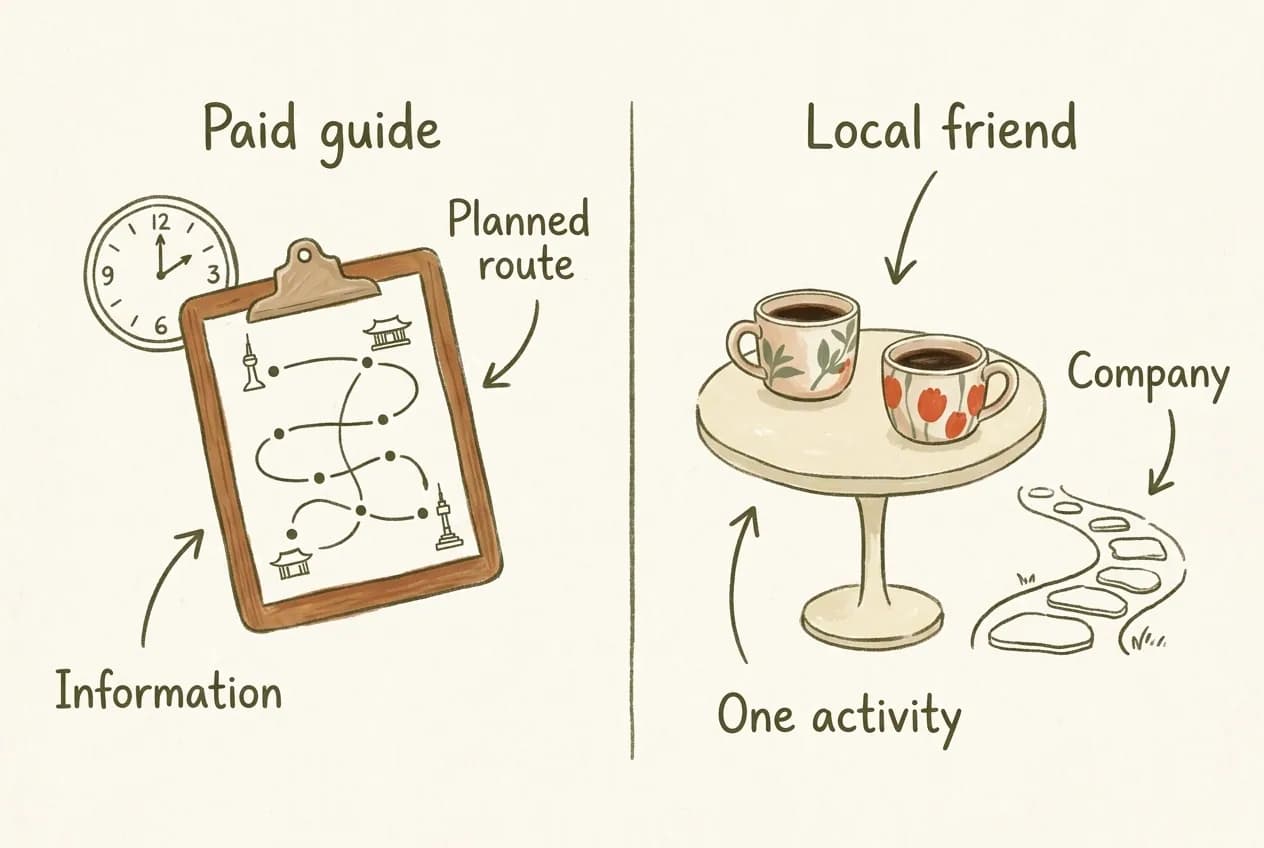
Hire a guide when you need history explained, translation for a full day, or logistics handled for a group. Meet a local when you want ordinary Seoul: a cafe, a market meal, a walk, and conversation. A guide gives you information. A local gives you company. Most trips have room for both, on different days.
Before you go
- Decide whether you want a social meetup or a paid service.
- Check the current availability and provider terms.
- Agree on the plan and any costs beforehand.
What is the actual difference between a guide and a local friend?
A guide is providing a paid service, and a local friend is not. That single fact shapes everything else. A guide plans the route, keeps the schedule, explains what you are looking at, and is accountable to you because you are paying. A local who meets you socially decides with you where to go, and can say no to anything.
| Licensed or private guide | A local you meet socially | |
|---|---|---|
| Relationship | Paid service, you are the client | Two people meeting, no money between you |
| Typical length | Half day to full day | One to two hours, one activity |
| Who plans | The guide, in advance | Both of you, loosely |
| Strength | History, translation, logistics, groups | Ordinary life, conversation, current local habits |
| Reliability | Contracted and refundable | Depends on a person volunteering their time |
| Coverage | Any site, any schedule you pay for | Whatever that person actually knows |
A little more detail
The second difference is scope. A guide is booked for a block of hours and expects to fill them. A social meetup is usually one or two hours around a single activity: a coffee, one meal, one walk through a neighborhood. Nobody is performing, and there is no itinerary to get through.
The third difference is what you come away with. A guided day leaves you with facts about Gyeongbokgung, the Joseon dynasty and the palace guard rotation. An afternoon with a resident leaves you knowing which side of the street people queue on, how a Korean twenty-something actually spends a Saturday, and what they think of the neighborhood you are staying in.
When is a paid guide clearly the better choice?
Pay for a guide when the trip has requirements rather than wishes. Travelling with parents who cannot walk far, a group of six who all need to be in the same place, a DMZ visit that has to be booked through an operator, or a day where you need continuous interpretation are all guide situations. You are buying certainty, and certainty is worth money.
A little more detail
A guide is also the right answer when your interest is genuinely specialist. Korean architecture, Joseon-era court ritual, the Korean War, contemporary art collections: a resident who happens to be free on Thursday is unlikely to know these in depth, while a professional with the national tourist interpreter guide qualification has studied them.
Finally, hire a guide when your schedule cannot flex. A paid booking holds at a fixed time on a fixed date. A social meetup depends on someone else's week, and their week can change.
When is meeting a local the better choice?
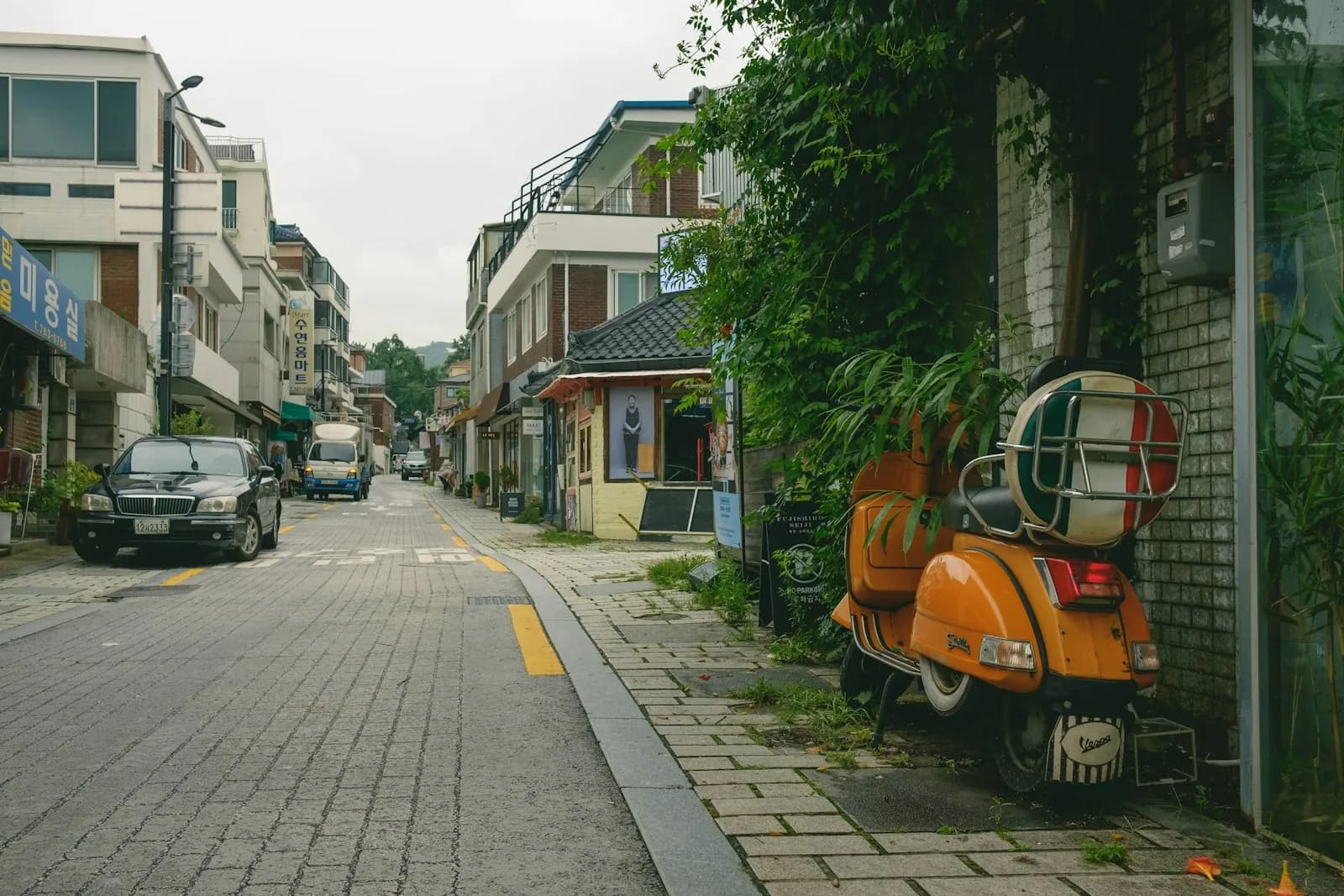
Meet a local when your question is not what to see but what it is like. Travelers who already have Gyeongbokgung, Bukchon and Gwangjang Market on the list usually do not need those explained. What is missing is a few hours of normal Seoul, and that is the thing a guided tour structurally cannot sell you.
- You want conversation more than commentary.
- You have one free evening rather than a free day.
- You are traveling alone and the trip has gone quiet.
- You want to eat where the queue is Korean, not where the sign is in English.
- You are coming back to Seoul and have already done the standard sites.
A little more detail
It also works well when your trip is short. On a three-day visit you probably do not want to give up a full day to a tour, but one coffee in Seongsu or one market dinner in Euljiro with a resident fits into an evening you had not planned anyway.
Solo travelers get the most out of it. Eating alone in Korea is normal and easy, but four days of it gets quiet. One conversation with someone who lives here changes the texture of a trip more than another palace does.
How does localseoul fit between the two?
localseoul is the social side, not the guide side. It is a free early-access service that matches independent travelers with ID-verified Seoul residents for coffee, food or a walk. Nobody buys anything, nobody is hired, and locals are not paid by travelers. After a verified meetup the local receives a KRW 10,000 Starbucks e-gift from localseoul, not from you.
A little more detail
You send one request with your dates, the neighborhoods you will be in, and a short message. ID-verified locals see it on a board, and one of them proposes a time and a public place. Most requests hear back within 48 hours; if you name a specific local instead, they have 72 hours to accept.
The honest limits: it is early access, the pilot covers twelve Seoul areas rather than the whole city, and a meetup only happens if a local chooses to accept. There is no guarantee, no refund to ask for, and no itinerary. If your day depends on someone showing up, book a guide instead.
Can you do both on the same trip?
Yes, and it is usually the best structure. Put the guide on the day with the heavy sites, where the explanation earns its cost, and put the local meetup on an evening or an unplanned afternoon. They do not compete, because they solve different problems.

A little more detail
A common pattern for a four-day first trip: one guided or self-guided palace and history morning, one day of neighborhood walking on your own, and one coffee or dinner with a resident somewhere near where you are staying. The local meetup tends to change what you do on the remaining days, because you come out of it with recommendations you would not have found.
What are the real downsides of the local-friend route?
The main downside is that it is not a product, so it cannot be guaranteed. A resident volunteering two hours can have a work emergency. A request can sit on the board if nobody in that neighborhood is free during your dates. Nothing about that is unusual for a free social platform, but it is different from a booking.
A little more detail
The second is coverage. A local knows their own Seoul: their neighborhood, their price range, their habits. If you ask for a Joseon history lecture or a full-day interpreter, you will be disappointed, and it is not what they signed up for.
The third is expectation. This is a meeting between two adults, not a service with a customer. Treat it as you would a friend of a friend who offered to show you around their city, and it works. Treat it as a free tour, and it will not.
Good questions.
Is a local friend a replacement for a tour guide in Seoul?
No. A guide provides explanation, translation and a scheduled itinerary you pay for. A local meets you socially for an hour or two and shows you what they personally know. They cover different needs, and many travelers use both on the same trip.
Do I tip a local who shows me around Seoul?
No. Korea does not have a tipping culture, and offering cash to someone who met you socially is awkward rather than generous. The normal gesture is to pay for the coffee or the meal, or to split it. Save tipping questions for paid guides.
Is it rude to ask a local to take me to tourist sites?
Not rude, but usually a mismatch. Residents rarely spend their weekends at the palaces, and a two-hour social meetup is not built for a site tour. Ask instead for the neighborhood they actually live in, or the food they eat on an ordinary week.
How far ahead should I arrange either one?
Guides and licensed interpreters book out weeks ahead in spring and autumn, so arrange those early. A social meetup is best requested one to three weeks before your dates, which gives locals in your neighborhoods time to see the request and reply.
Plans and opening hours can change. Check the venue or official source before you go. How we put these guides together · Suggest a correction
Get a feel for the neighborhood.

Keep exploring.
All guides ↗ Find your fit
Planning for a private guide
What to check before you book.
 Find your fit
A walking tour or a walk with a friend?
Know what you’re signing up for.
 Find your fit
Paid hosting or a social meetup?
Choose the kind of company you want.