Couchsurfing Hangouts vs verified local matching in Seoul
Compare two ways to find company.

Here’s what to know.
Couchsurfing Hangouts is an in-app feature for meeting people who are free right now and nearby, which makes it fast and unpredictable. Verified matching works ahead of time: you describe your dates, an ID-verified resident accepts, and you agree a public place. Hangouts is better for tonight; matching is better for a meeting you can plan around.
Before you go
- Decide whether you want a social meetup or a paid service.
- Check the current availability and provider terms.
- Agree on the plan and any costs beforehand.
What is Couchsurfing Hangouts?
Hangouts is a feature inside the Couchsurfing app, separate from the hosting side the platform is known for. You post that you are free and want to do something, other users nearby see it, and anyone interested can message you. It is designed for the next few hours, not the next few weeks.
A little more detail
Couchsurfing also moved to a paid membership some years ago, so using the app, including Hangouts, now requires a subscription. That is a change many travelers who used it a decade ago do not expect, and it is worth checking current terms before you count on it.
The population in Seoul skews towards other travelers and short-term residents, because those are the people who open a travel app while sitting in a hostel. Korean users exist, but you have less control over who replies than the feature's framing suggests.
How does planned verified matching work instead?
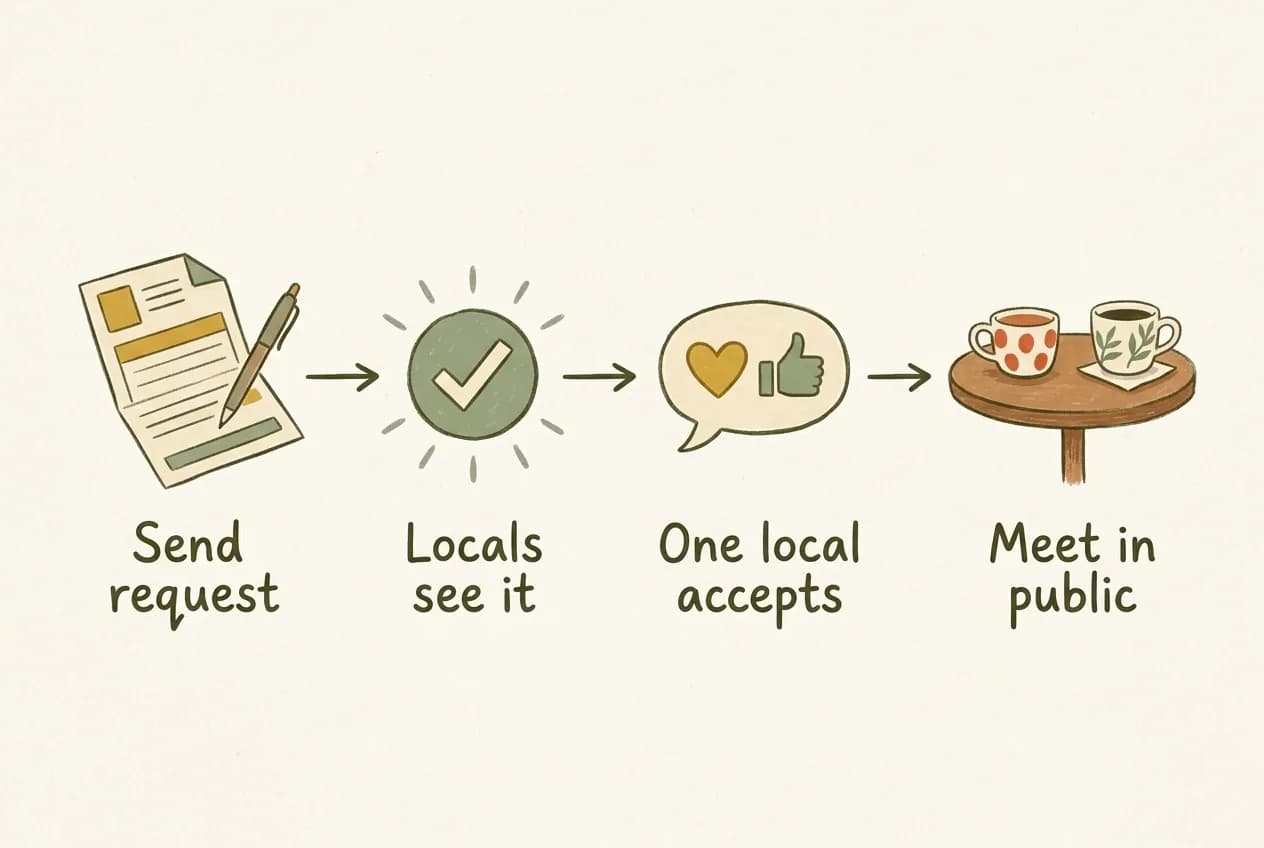
You submit your trip once, in advance, rather than broadcasting availability in the moment. A request carries your dates, party size, the neighborhoods you will be in, your interests and a short message. Verified residents see it and one of them chooses to accept, then proposes a time and a public meeting place.
| Couchsurfing Hangouts | Verified one-to-one matching | |
|---|---|---|
| Timing | Now, or the next few hours | Planned days or weeks ahead |
| Who can reply | Any app user nearby | Only ID-verified locals on localseoul |
| Who you meet | Often other travelers | Seoul residents |
| Cost | Requires a paid Couchsurfing membership | Free during localseoul early access |
| Control over match | Low, first to message | Higher, you set dates and areas |
| Reliability | People flake, it is normal | A local commits to a proposed time |
| Coverage | Wherever users are | Six pilot neighborhoods |
A little more detail
The identity step is the structural difference. On localseoul every local submits a masked government ID and is manually reviewed before appearing, and ID copies are destroyed within 30 days of verification. On an open in-app board, anyone with an account can reply to you.
The cost of that structure is speed. Nothing about verified matching helps you at 8pm when you are bored in your guesthouse. It helps the version of you who planned a week earlier.
Which one gets you actual Seoul residents?
Matching, by design. The service exists to list people who live in Seoul, so a match is a resident by definition. Hangouts returns whoever is nearby and free, and in tourist districts that is disproportionately other visitors.
A little more detail
That is not a criticism of Hangouts. Meeting other travelers is genuinely valuable, especially if you are solo and want someone to eat dinner with tonight. It is simply a different outcome from talking to someone who grew up in the city.
If your reason for the trip includes understanding Korea rather than meeting international people in Korea, the distinction matters more than the speed difference does.
What about safety and screening?
Couchsurfing relies on public profiles, references and a verification badge users can pay for. That is real information, but a new account with no references can still message you, and the volume of replies to a Hangout makes it hard to read any of them carefully.

A little more detail
localseoul screens on the local side before anyone appears: masked government ID, manual review by the team, and a permanent ban for any solicitation of money or sexual services. Your email is shared with exactly one local, and only after you are matched. Reports are handled within 24 hours.
Neither system removes your own judgement. Meet in a public cafe, keep the first meeting short, tell someone where you are, and leave if it is not working. That advice does not change with the platform.
When is Hangouts still the better tool?
When the trip is already happening and the plan fell through. A spontaneous feature is unbeatable for tonight, and no planned service competes with it on that axis. If you are in Hongdae on a Friday with an empty evening, an open board of people who are also free is exactly right.
- You are already in Seoul with an unplanned night.
- Your itinerary is loose and could change tomorrow.
- You want company for dinner more than local knowledge.
- You are happy meeting other travelers rather than residents.

A little more detail
It is also better if you are moving fast or your dates are unclear. Travelers doing three cities in ten days cannot reliably commit to a coffee on Thursday in Seongsu, and a planned match is wasted on them.
And it is better if you want a group. Hangouts often turns into several people going to the same bar, which is a different and perfectly good evening.
What are the honest limits of the matching route?
It is early access, so the pool of locals is still growing and the pilot covers twelve areas rather than the whole city. A request in an area with few active locals during your dates may not be picked up at all.
A little more detail
It also depends entirely on a person choosing to accept. There is no guarantee, no purchase, and nothing to refund. Locals are not guides and are not paid by you; after a verified meetup the local receives a KRW 10,000 Starbucks e-gift from localseoul.
And it is slow by design. Most requests hear back within 48 hours, and a directly named local has 72 hours to reply. If you need something this evening, that is the wrong tool and Hangouts is the right one.
Good questions.
Is Couchsurfing still free?
No. Couchsurfing introduced a paid membership requirement some years ago, so using the app including Hangouts now involves a subscription. Check the current terms in the app before planning around it, since pricing and trial conditions have changed more than once.
Do you meet Koreans on Couchsurfing Hangouts in Seoul?
Sometimes, but the users active in tourist districts skew towards other travelers and short-term residents. If meeting someone who actually grew up in Seoul is the point of the exercise, a service that verifies residents will get you there more reliably.
Which is safer for a solo traveler?
A service that verifies identity before listing anyone gives you more to work with than an open board where any account can reply. Neither removes the basics: meet in public, keep the first meeting short, tell someone your plans, and leave if you feel uneasy.
Can I use both?
Yes, and they cover different gaps. Send a matching request before you fly for a planned afternoon with a resident, and use a spontaneous app once you are in the city for evenings that open up unexpectedly. Neither one blocks the other.
Plans and opening hours can change. Check the venue or official source before you go. How we put these guides together · Suggest a correction
Get a feel for the neighborhood.

Keep exploring.
All guides ↗ Find your fit
One coffee or a group event?
local/seoul and Meetup, compared.
 Find your fit
A quick hello or a lasting friendship?
local/seoul and friendship apps.
 Your kind of trip
Meet people. Keep your boundaries.
Practical habits for solo travelers.